Tuesday, February 5, 2013

RWH tour for students of Golden Valley CoE, Madanapalle

11 final year Civil Engineering students and their guide (an Engineer with the Irrigation department) visited different types of RWH installations today alongwith BIOME as part of their final year project. The trip had a good mix of both theory and site visits. They went to  SISA Kendra, Rainwater Harvesting Theme Park, Rainbow Drive and Sobha Quartz - each presenting a different aspect of RWH to the students.

Some thoughts and information that stayed with us post the visit

  1. The students had collected the daily rainfall data for the past 5 years from the tehsildar's and irrigation dept. offices and were keen to share it with us
  2. They had ideas on how RWH and Waste Water Treatment could be implemented back home. We wait to hear from them
  3. Their guide had been deeply moved by the water episode on "Satyamev Jayatae" and thought it important that something be done about the same. He has been at it and trying out different ideas for the past few months. This RWH tour being one of the attempts too
  4. The willingness, pride and enthusiasm with which, the people that have implemented RWH like to talk about it is also an amazing feeling. A very warm thanks to all the folks at each of the venues that helped us by allowing us to use the facilities at the premises as well as interacted with the students
We should do more of these !!
Theory session at SISA Kendra

At the RWH park


Shobhit explains: Recharge Wells at Rainbow Drive
RWH Theme Park
Sobha Quartz basement
Final Group photo
The customary tea - just before winding up

Monday, February 4, 2013

RWH at SISA Kendra

SISA Kendra, a school in Whitefield implements rooftop rainwater harvesting. Water from about 800sqm of rooftop is stored in a 30,000 liter sump as well used for borewell recharge as part of the implementation. The harvestable potential is about a quarter of a million litres. Great effort, involvement and coordination from the school management, administration and teaching staff. The next step is to try and put in place an appropriate system to treat and reuse waste water.
Testing the bricks 


Excavated sump
Sump walls completed
Vishwanath addresses the audience
RWH system inauguration


A great honour to be invited to their annual day. Mr Reddy inaugurates the system. 

Tuesday, December 11, 2012

Waste Water Treatment & Reuse at Fern's Paradise Layout,Bangalore .

The waste water treatment process at this layout has been revamped as part of the continous water conservation efforts by the water concious residents. Initial waste water treatment system was not preferred by residents because (a)It was not accessibile(due to design)for inspection and maintenance. (b)Output water quality was not consistent. The new Aerated Wastewater Treatment system in use includes 4 stages : (1) Waste water(grey & black) flows into a settlement chamber from all houses. Here settlement of heavy solids and breakdown of solids by microbes/bacteria takes place . (2)Partially clarified waste water from stage 1 is mixed with air to assist bacteria to further treat it. (3)Treated water from stage 2 flows into a second settlement chamber enabling further settlement and breakdown of suspended solids . (4)Stage 3 output is treated with chlorine and other disinfectants . This treated water is good enough to be used for gardening purpose. A local entrepreneur collects the above treated water in a syntax tank mounted on a lorry and sells it to the households for gardening . Due to this innovative distribution system , the water consumption for gardening has come down significantly in many houses of the layout. Check out these video for more ! (1)http://youtu.be/RcfvgP1rPkc (2)http://youtu.be/7MaRxajc3fU

Monday, November 26, 2012

Rainwater Harvesting at Jakkur Govt. School

  Biome has designed and installed a Rainwater Harvesting system(RWH) for the government school in Jakkur , located at outskirts of Bangalore. An awareness session on RWH was also conducted by the Biome team for the school students . These activities were conducted as part of a CSR initiative by a leading MNC .
   The rainwater harvesting system has been designed to harvest the rain falling on the school's flat rooftop (approx 10,000sq ft area) . As per the existing construction , all the rooftop rainwater was being drained out by 4 downpipes located on the rear wall of school building . Hence this water was of no use to the school. To harvest this rainwater ,the downpipes have been connected to a horizontal pipe with a gradual downward gradient along the wall. This pipe after collecting water from all the down pipes carries the water into a new storage tank of approx 8000L storage capacity located on the front side of the school building.This storage tank has been made by utilizing a cylinderical cistern lying unused in the school premises. An overflow provision has been given from this new tank to an existing , adjacent storage tank. A first rain separator takes care of draining out the initial rain which has the maximum contaminants.The tanks have been closed with top slab covers.Also, taps have been provided at the base of these tanks for drawing out water.
   Its interesting to note here , by constructing the storage tank above the ground and by utilizing stone slabs and cisterns, otherwise lying unused in the school , the overall cost and duration of construction have been reduced significantly.
   To generate awareness about rain water harvesting an interactive session was held with students and a site tour demonstrating the new RWH system was conducted .School students along with the energetic employees from the MNC volunteered to clean the rooftop to be used for rainwater collection. To prevent clogging of pipes and to maintain good quality of water, students were encouraged to regularly clean the rooftop and monitor the RWH system. The collected water can be used for gardening and washing utensils after midday meals in the school.
   Through this exercise it is hoped that not only will the school be able to meet its water needs more efficiently , but with students as participants in the whole exercise, the message of sustainable water management using rain water harvesting will go well beyond the boundaries of the school !

First Rain Seperator


Interactions with students

Overflow pipe

Storage tanks with taps(Left tank is new, Right tank is older)


Front side pipe network

Backside collection pipe (going to the front side)

Backside downpipe & collection pipe (going to the front side)

View of 2 slab covered storage tanks from top .
      

Sunday, November 25, 2012

Women and Water : Catalysing Leadership in Bangalore

Biome presented a paper at the National Conference on "Women-led Water Management: strategies towards water sustainability in rural India" held on Nov 5-6, 2012, at Gurgaon, Haryana. The Conference was jointly organized by The Institute of Rural Research and Development and UNICEF India. The link below directs you to the presentation that was made.


The role of women and water in running households, whether urban or rural, rich or poor, illiterate or educated cannot be overemphasized. It is but natural and intuitive to assume that women should play a key role in policy-making around water. However, much like across rural India this role is mainly played by men - even in the cities. This paper follows two different scenarios in and around Bangalore where women have come forward to play water policymaker roles. In both cases women have not only looked at water from a sourcing, supply and management point of view but primarily from a view of ensuring sustainability.


The first scenario illustrates the coming together of key women members in the water committee of a Resident Welfare Association (RWA) in a high-income, gated community called Ferns Paradise. These women invested much of their time, effort and money to ensure sustainable water supply by looking at demand management, rainwater harvesting and wastewater treatment. The second scenario highlights the efforts of teachers, cooks, and female community group members in rural Bangalore, and the challenges they overcame to secure their village water supply.

Although apparently from opposite worlds, this paper shows that the two communities had the common interest of ensuring sustainable water supply especially for the future generations. Our organisation Biome (Biome Environmental Trust) was able to observe their successes as they unfolded first hand.

Tuesday, October 2, 2012

Deep, Deeper, Deepest

A rare cuboid shaped  100ft deep well in Byrapura, Devanahalli  - privately owned by Venkatesh. It really is quite a site to see. Also hard to imagine how it might have been dug

Much like all other wells in the area, this well too has run dry. Venkatesh says its been dry the past 10 years. When he was a teenager he remembers swimming in the well. When he was still younger he thinks it used to fill to the brim. The ledges (for placing the motor) at different levels - deeper every time -  tell the story of the falling water levels.

Tuesday, September 25, 2012

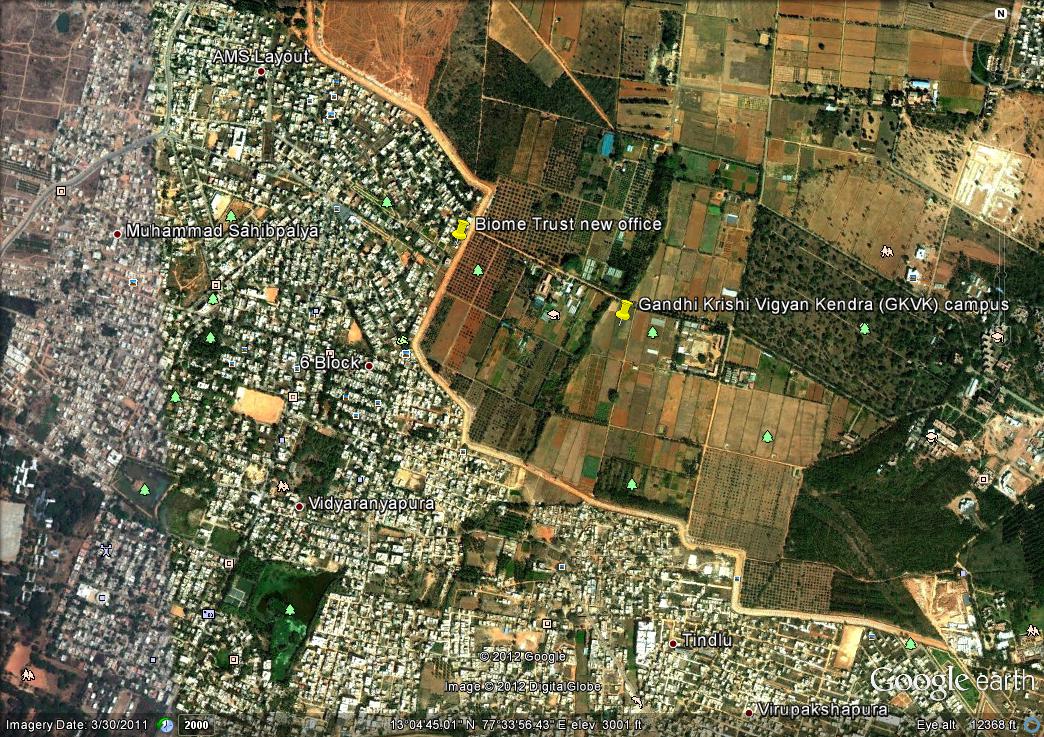
Biome Trust has a new address

Hi all, we have now shifted to a new office located in Vidyaranyapura itself. The address is: 291, 1st Cross, BEL Layout, Vidyaranyapura, Bangalore 560097. Phone number: 080-4113 1908