- Sustainable water management initiatives including Water Demand Management, Rainwater Harvesting, Water supply and Sanitation Infrastructure improvement, water literacy activities and volunteering activities with WIPRO Employees.
- Rejuvenation of community open wells
Wednesday, October 11, 2023
Biome at the Spirit of WIPRO Run
Awareness Session for Sama Foundation
The Biome Environmental Trust team conducted an awareness session on water conservation for the Sama Foundation at Devara Jeevanahalli, popularly known as DJ Halli, Bengaluru. This was the first interaction between the Biome team members and the Sama Foundation members.
Date and Time - 6th October 2023, 11 AM to 2 PM
Venue - Sama Foundation, Youth Center, DJ Halli, Bengaluru
About Sama Foundation:
- Education: Sama Foundation has worked towards reducing the dropout rate of children in pre-primary school. They have introduced post-learning initiatives like tuition. They have brought up the idea of pair learning among the students to build self-confidence and self-awareness. For youth of the age group 18-30 years, they offer a 3-month skill development course, that includes communication skills, digital literacy, guidance for career growth & development, spoken English etc
- Health: They conduct health camps from time to time. They coordinate with government hospitals and spread awareness regarding chronic diseases, Government insurance policies (like Ayushman Bharat), etc.
- Social benefits: They work towards the holistic development of the community. Given the plethora of government schemes available for marginalized communities, they create awareness regarding financial literacy, pensions etc. They aim to empower women and children by connecting them with government schemes and benefits.
- They have conducted surveys on 10,000 households in the locality. They conduct meetings regularly involving at least 300 households.
Biome’s interaction with the Foundation:
- The community faces an ongoing water crisis, with many places getting water once every 5 days. As a result, people need to buy RO water for their water requirements.
- The area faces flooding during the rainy season due to improper solid waste management and the terrain.
- The quality of the water from the Municipal connection is not up to the mark.
- The sewage and water pipelines need to be mapped and monitored.
Agenda proposed by Biome:
- Understand the Water demand of the community and revive the wells accordingly: The entire area can be segmented into small settlements, and the water demand of each settlement should be calculated. Accordingly, the wells nearby can be prioritized for revival. A questionnaire can be prepared and distributed to households to understand their water needs.
- Water quality study: The quality of water needs to be monitored regularly for tap water and well water. A module educating them regarding the salts dissolved in water, the pathogens present, the contaminants, and the harmful effects can be compiled and distributed to the people.
- Rainwater harvesting in Government schools: Identify a school in the locality for rainwater harvesting and groundwater recharge. This will act as a model of best practices of water management for the entire community.
- Local Involvement: Identify the plumbers and masons in the locality and involve them in implementing the work. This helps in social inclusion and skill development of the community youth.
Blog written by Apeksha Deshpande
Saturday, September 23, 2023
Shubha's talk for BMSCA
In collaboration with the Council of Architecture, Pune, BMS College of Architecture, Bengaluru, organised a 5-day online conference on "URBAN COMMONS-Opportunities & Approaches" from September 11th to 15th, 2023. Shubha Ramachandran of Biome was one of the invited speakers - her session was titled ‘Urban Waters: Learnings from Bengaluru City’.
Shubha’s session on the second day was attended by 33 participants.
Monday, September 4, 2023
Day Zero
Day Zero was a play staged at the Alliance Francaise in Bengaluru on Sept 2 and 3, 2023. The India Foundation for the Arts supported it under their Program 360. Vishwanath Srikantaiah collaborated with Ram Ganesh Kamatham in writing the script of the play.
The following note is from IFA’s website.
‘The play’s title Day Zero refers to the imminent water crisis in the city of Bangalore, in the case of a drought. Bangalore has been developed unsustainably in many ways – particularly with regard to the flow of water through the city. Atop the Deccan Plateau, Bangalore has no significant source of water except for a tributary of Arakavathi called Vrishabhavati. With the rapid growth of the population in the city since the 1990s, poor water management in Bangalore has also exposed its urban precarity. The imagery of water movements in the city, like expensive piping from the Cauvery, the water tanker mafia, excessive borewell drilling and a falling groundwater table, points to the story of urban inequalities as well. At the heart of this play are the paradoxes of Bangalore’s development and its disparities, and a future-focussed approach towards sustainability.
In the play, the movement of the water will be explored, both literally and figuratively. In a literal sense, there is a cascading network of kere (lakes) and kaluve (canals) in Bangalore, through the topographical four ridge-valley systems of the city, involving Hebbal, Chellaghatta, Koramangala and Vrishabhavati. Figuratively, it is about the emotional content related to rainfall, tears and sweat, drinking water, drainage and submerged/ subterranean structures.
The play will engage with the metaphor of water in the city, through intersecting timelines from the past and the future. One potential fragment of the play will be set in a dystopic future in 2035, when the city has been submerged under water, and only a few of the citizens are able to live above the waterline. These privileged few are occupying the superstructures built as a part of the fictional Vrishabhavati Urban Rejuvenation project. This dystopian narrative has a protagonist who is a glass cleaner, originally from the Manuvaddar/ Bhovi caste, who are well-diggers. The story will unfold, from a request for a glass of water. Another fragment in the play will be set in the colonial past of Bangalore when boxing was a craze in the city. The protagonist will be a boxer in the 1930s who wanted to survive three rounds with the local boxing champion, Gentleman Gunboat Jack, whose real name was James Colzie. After challenging him to a fight at the Opera Theatre on Residency Road, the protagonist, who is drenched in sweat, is wondering to himself, how he got himself into such a mess.
The staging of the play will involve soundscapes, cartographic data such as topography and GIS data, and elements of verticality drawn from the aesthetics of climbing sports.’
Friday, September 1, 2023
Reconnaissance survey of Nayandanahalli Kere
Nayandanahalli Kere

Introduction
In our mission at Biome Environmental Trust to foster sustainable water management, we continuously seek opportunities to integrate conventional and modern water-saving technologies. Our most recent reconnaissance survey led us to Nayandanahalli Lake, a unique water body that receives tertiary treated sewage water. This blog aims to detail the findings of our preliminary survey and explore the lake's potential to serve as a pilot for integrated water management systems in urban and rural contexts.
Location & Accessibility
- Address: Nayandahalli Lake, ITI Layout 3rd Phase, Dr Ambedkar Nagar, Nayanda Halli, Bengaluru, Karnataka 560039
- GPS Coordinates: 12°56'16.8"N 77°31'16.3"E
- Entry Point: Accessible from the main road - Mysore Road
In January 2023, the lake received a fresh lease of life. Tertiary treated water from the BWSSB Sewage Water Treatment Plant (STP) is now being routed into the lake. This unique approach to wastewater management promises enhanced water quality and could serve as a template for other urban lakes.
Comprehensive Overview of Physical Attributes and Hydrological Parameters
Area: Approximately 34,000 square meters, with a very small island dominated by bamboo trees
Perimeter: About 800 meters
Depth: 9 feet on the east side and 15 feet on the west side near the outlet or waste weir
Inlets: Two, one on the east and another on the south, with the east currently active.
Infrastructural Elements
- Walking Path: A 7-foot-wide walking path supplemented by an extra 3-foot-wide buffer zone for plantation
- Open Drains: These are strategically placed to route rainwater from the walking path into the lake
- Stonework: The lake is stone-pitched along its internal periphery, aiding in erosion control
- Flora: A variety of plants including guava, Singapore cherry, and other ornamental bushes
- Facilities:
24/7 security personnel, Street lighting along the perimeter, Bathrooms situated on the east side, A triangular garden space in the northwest. The presence of a high-tension electricity pole near the lake’s boundary was observed.
Water Quality Assessment
- Visual Inspection: The water appears clear with no visible signs of plant or algal growth
- Odor Test: A strong smell of chlorine was noticed, but only near the inlet where the STP water is released
Ecological Impact
Nayandanahalli is home to a few species of birds including common moorhens, little grebes, coots, and purple moorhens.
Potential for Future Water Management Initiatives
Given the successful integration of tertiary treated sewage water, Nayandanahalli Lake offers an opportunity for further advancements in sustainable water management. Specifically, its relatively stable ecosystem and recent rejuvenation make it an excellent candidate for integrating shallow aquifers like open wells or filtered bore wells into a holistic water management strategy.
Future steps include comprehensive hydrological and environmental studies to determine the lake's capacity to contribute to the water security of nearby localities.
For more updates on Biome Environmental Trust’s water management initiatives, please stay tuned to our blog and social media channels.
Blog by Ayushi Biswas
Monday, August 21, 2023
Biome Participation in Youth Climate Conclave
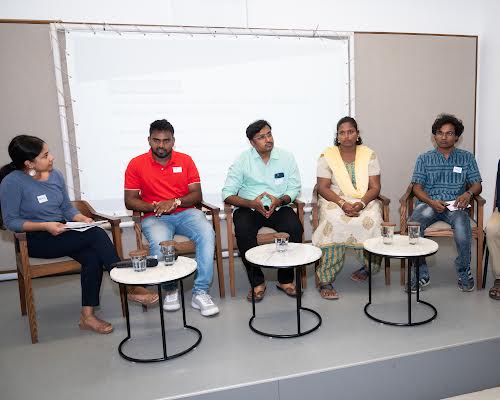
Restless Development India (url) organised a Youth Climate Conclave on 14th Jul 2023. This event was organised as a platform for nurturing new ideas, building connections, and encouraging collective action towards making Bangalore inclusive for all. Biome was invited as panelist for the session "How youth-led actions can catalyze community response in addressing climate change challenges"
Event Date : 14th July, 2023
Event Venue : Bangalore International Centre, Domlur
The opening Keynote speaker was Mr. Anand Malligavad of Malligavad Foundation. He spoke about his journey in reviving lakes and the practical challenges he faced. He also said that self belief and persistent efforts are very important in any endeavor, and that the results will take time to show up.
Panel 1 Topic : How youth-led actions can catalyze community response in addressing climate change challenges
Panelists
- Mr Mayur, Youth Climate Champion, Restless Development
- Mr Koushik Dhayal, Youth for Parivartan
- Mr Srinivas, Biome Environmental Trust
- Ms Shalini, community leader from Mahila Housing Trust
Moderator : Ms Parvathi, Restless Development’s Youth Climate Champion
The first panel brought together perspectives from individuals and organizations who are championing action on the ground in tackling some of the key challenges that the city is facing today. The discussion focused on the crucial role that youth-led actions play in enabling community-driven change in the city. The conversation looked at the opportunities and challenges faced by youth-led initiatives in the areas of cleaning up the city, water conservation and low cost housing.
Panel 2 Topic : Facilitating Partnerships & engaging with youth led initiatives - Experiences, impact and learnings
Panelists
- Mr Anirudh Dutt, Founder of Let’s Be The Change
- Ms Pinky Chandran, Independent Journalist
- Ms Vrinda Kapur, Grants Manager at Porticus Foundation
Moderator : Mr Abhishek S, Restless Development Youth Climate Champion
The second panel reiterated the importance of a conducive ecosystem for youth-led change, through the lens of some of the key stakeholders. The discussion was mainly focused around how community level initiatives can be effectively organized through partnerships and what can be learnt from the past experiences. One of the most echoed thoughts was the importance of having persistent belief and working towards the goals, and the time and efforts it takes to convert scalable partnerships. The panelists delved on the criticality of inclusive grant-making that permeates effectively into community action with the right support of advocacy, communication, involvement of decision makers and community champions.
Namma Kere Event
The first of its kind, this is an initiative by Citizens of Sankey and Bengaluru Praja Vedike to preserve and manage lakes of Bengaluru. The event mainly had two presentations by experts followed by a panel discussion.
Topic of discussion: The gaps in lake management & preservation, actionable solutions.
Date & time: 19th August 2023 from 10 AM to 1.30 PM
Venue: Seva Sadana, Malleshwaram, Bengaluru
Speakers & Panelists:
(Prof) Dr T V Ramachandra, IISc
Dr U V Singh, IFS(R)
Prof Rajeev Gowda - ex-MP & Academician
Mukund Namagundlu - Civic Activist
Smaran Shetty - Environmental Lawyer
Preeti Gehlot - Special Commissioner for Lakes, Bengaluru
Vasanthi Hariprakash - Moderator
The discussion had two parts - a presentation by Prof Dr TV Ramachandra and Dr U V Singh and a panel discussion with the experts.
Key takeaways from Prof T V Ramachandra’s presentation:
Background:
Currently, Bengaluru has 193 lakes and less than 4% tree cover
An unpolluted lake generates a revenue of around Rs.10,500/day/hectare, while a polluted lake only generates Rs.20/day/hectare. Eg- Amruthahalli Lake
Groundwater table & lakes: Removal of lakes decreases the groundwater level from 600’ to 80-100’ while the presence of a lake increases the groundwater table from 800’ to 350’ a year (Sarakki Kere)
Problems involved:
Lack of understanding of lakes
No scientific rejuvenation - Emphasis on civic recreational work rather than eco-restoration; in the name of remodeling, there is only concretisation
Unplanned urbanization
Lack of proper solid waste management
Unscientific rainwater storms
Distribution of pollution (biomagnification) through fishes, vegetables etc
Plausible solutions:
Reuse and recycle wastewater
Compulsory tertiary treatment of wastewater before releasing into lakes.
A successful case study - Revival of Jakkur lake - around 300 wells around Jakkur were revived, and none tested positive for nitrogen and phosphorus.
Mini forest in each ward - a self-sustaining system around the lake
Proper rainwater harvesting set-up can solve most of the water scarcity problem of Bengaluru.
Increase in environmental literacy involving the public and the youth.
Key takeaways from Dr U V Singh’s presentation:
Recommendations for lake conservation (administrative measures):
Inventory of all tanks (live and proposed lakes ) in Bengaluru
Invoking Karnataka Lake Conservation and Development Authority Act, 2014
Appointment of Chief Executive Officer by amending KTCDA Act
Appointment of authorized officers, required staff and planning regular meetings with them
No development of any lake or tank until an STP (Sewage Treatment Plant) is set up for the lake.
Key takeaways from the panel discussion:
- Retain the lake as a part of the environment rather than making it human-centric. Maintain the integrity of lakes by considering the physical (less concretisation) and chemical (not releasing industrial effluents) components of the lake.
- Propose a dedicated website for lakes in Bengaluru that includes a list of live lakes, encroachments, recreational activities, etc.
- Establish a structured Community Participation Forum for each lake that includes the following:
Involve a group of 10 people around the lake as the members of this Forum; maintaining the lake and the website should be their responsibility.
Train the members effectively and arrange informative sessions by experts
The community should have one government representative to smoothen the legal functioning
Revenue from the lake should be recorded and updated on the website regularly
Declare all lakes as heritage sites to prevent any type of encroachments
- The committee meetings should compulsorily involve representatives from the public. Also, EIA (Environment Impact Assessment) reports should be more scientific and transparent
- Environmental education should be made compulsory for all governmental employees, Politicians, private players and academicians to create awareness
Blog written by, Apeksha Deshpande


.png)


.png)