Tuesday, February 21, 2023

Farming with treated wastewater in Bengaluru

 Mr Arun’s two-and-a-half acre farm lies in the middle of what has grown to be a bustling part of the IT corridor of the city of Bengaluru. Located on Halanayakanahalli lake road, off Sarjapur road, and only about 500 meters from the Halanayakanahalli lake, Arun tries his best to maintain an organic farm in the midst of high-rise buildings, pollution and water scarcity. Though there is a lake close by, many apartments still face water scarcity issues in this area, especially during the dry season.


Halanayakanahalli road on the map


Multiple native fruit trees are grown on one acre and a whole acre is dedicated to growing fodder for the 2 cows and 2 calves that live on the farm. Multiple millets and vegetables used to be grown here a few years back but grazing lands have disappeared from the area in only a few years to make way for high-rise buildings. Due to this Arun is now growing fodder to sustain his cows in his farm itself.


There is a 460 feet deep borewell on the farm. Water from this borewell is used to sustain the caretaker’s family as well as multiple farm animals.


Arun runs a small-scale building firm. He aspires to work on ecologically sustainable buildings. While researching water management for his company’s first project (Vizipa Optima - an apartment complex), he learnt about various issues with water management throughout the city. He also developed a keen interest in wastewater treatment during this time and saw a great opportunity in using treated wastewater on his farm.


He has now arranged with various treated wastewater tankers to supply water for his trees and crops. Around 2 to 3 loads of tankers in bought every day to water parts of the farm. Watering the whole farm in summer would require more than 10 loads per day. Currently, there is no cost to the treated wastewater with the engaged tanker contractors and water is ordered on a need basis. There is no drip irrigation system on the farm. The field is irrigated through furrow irrigation.


Arun’s farm is a great example of how treated wastewater can be put to good use, thus reducing demand pressure on freshwater sources. Since treated wastewater is also relatively rich in nutrients, this also reduces the need for fertilizer on the farm reducing the overall environmental footprint.


The farm


-Neelima Ramesh

Friday, February 10, 2023

Some thoughts on direct borewell recharge (June 2019)


This summer has been a cruel one – all across the city, borewells have been running dry – many for the very first time since the borewell was drilled. The reason for this is the long dry spell that we’ve had – the weakening of the monsoon in Sept – Oct last year followed by the non-existent NE monsoon and the delayed pre-monsoon this year. The groundwater table has fallen precipitously with extraction continuing to remain the same, with minimal or no recharge of the groundwater table.

In this scenario, many people whose borewells have run dry (and many who fear that they may do so eventually) are very keen to recharge their borewells, hoping that by doing so with the monsoon rains this year, they may not have to face a similar situation next year.

There are several service providers who have made a name for themselves doing direct borewell recharge, especially in the dry rural areas of Karnataka and Maharashtra. There are also NGOs that provide this as a free, voluntary service.

Borewell recharge can be done either directly or indirectly. Direct borewell recharge involves digging a pit around the borewell – the depth of which can vary from 8 to 20 feet. At the bottom of this pit, the borewell casing is punched with small holes or slits, and is wrapped tightly with several layers of fine mesh. The pit is then filled with several layers of graded gravel (jelly stones) and sand, or sand and charcoal. This serves to filter the water that flows into the pit before it enters the borewell through the punched holes.

In urban areas, rainfall runoff water from the nearest rooftop is channelled into this pit, and thence enters the borewell. Usually, surface runoff from rain falling on the paved areas around a building is not used, and is not advisable to be used, as it carries with it petrol, diesel, brake oil, carwash detergent, floor cleaner, weedicides and pesticides from the garden etc, aside from fallen leaves and silt. Maybe even dog and cat poop.

In rural areas, the surface runoff from the fields is used to recharge the borewell. Since this contains huge amounts of silt, there is a holding tank built upstream of the borewell pit, that acts as a giant silt trap. The rainfall runoff from the fields is channelled into this tank, in which the silt settles, and then the clean supernatant water is channelled into the borewell pit. In practice, it doesn’t always function this way – if there is heavy or prolonged rain, the holding tank fills up very quickly, and muddy water flows into the borewell pit, as there isn’t enough time for the silt to settle in the tank.

While the graded gravel, sand and charcoal filter out a significant amount of the silt in the pit, some mud – especially the fine particles of clay – will enter the borewell through the fine mesh and the punched slits. Over a period of time, this clay will settle at the bottom of the borewell, and may even block the bottom- most fissures that feed the borewell. They may even pass through the fissures and enter the deep aquifer from which the borewell draws water – an aquifer deep within the rock, in which water has accumulated after being filtered through the various layers of the topsoil, the weathered zone and the bedrock over countless years.

At least this clay just muddies the water in the deep aquifer. Along with it, the runoff water from the fields contains significant amounts of fertilizer, pesticides and weedicides that go into the borewell, and from there into the deep aquifer, contaminating it forever. There is no filter that can filter out the chemicals in the water... 

Direct borewell recharge is so attractive because it gives immediate results. After a single good rain, a dry borewell miraculously comes to life. This method is sought after not only by people whose borewells have run dry, but also by those whose borewells have water – they wish to ensure that their borewells’ yields will continue to be good in future if it is recharged in this way.

A wiser approach to borewells would be:

  • If it is functioning, don’t disturb it

  • If it never yielded water, forget about it

  • If it yielded water and has run dry due to groundwater depletion, wait for the rain to recharge it

And here, we can certainly give the borewells a helping hand – by doing indirect recharge through recharge wells. A recharge well is a structure that is dug along the path of flowing runoff water, such that the water enters it and percolates into the ground. For the geology of Bangalore and surrounding areas, it has been found that a depth of at least 20 feet is needed for a recharge well to send water into the weathered zone, rather than into the topsoil. Consistent recharge over some years has been shown to revive shallow borewells, and also dry open wells.

The best place to store harvested rainwater is the shallow aquifer. And the way to do it is to dig recharge wells. 


Wednesday, February 8, 2023

Wells in Hunsamaranahalli - In the media

Cleaned and recharged, six wells spring to life in B’luru suburb | Deccan Herald https://www.deccanherald.com/city/bengaluru-infrastructure/cleaned-and-recharged-six-wells-spring-to-life-in-b-luru-suburb-1188237.html


Tuesday, February 7, 2023

Can there be win-win situation in Waste Water Management

 An apartment with 300+ homes, near a lake and adjacent to a large highway faces a constant basement seepage problem. They also have the problem of excess treated waste water and not having sufficient avenues to utilise it. Some creative and co-operative thinking results in this lemons to lemonade solution

1. An existing open well in the basement serves as the receptacle for seepage from the lake, surface rainfall runoff and excess STP treated water, thereby protecting the basement

2. A smart company sets up a water treatment plant to pick this mixed water up and treat it to potable water quality standards. The water is then sold to a nearby laundry

3. The water treatment company pays the apartment a monthly rental for the space and also pays the energy bills

4. The treated water is sent to the laundry in those very tankers that used to supply borewell water to the laundry

5. The laundry benefits from the soft water (as opposed to the hard water that they got from borewells) that drastically reduces the need for detergent as well as reduces the complexity and resource requirement for the treating the used water in the ETP

6. While there are ways in which each of these systems can be bettered, it demonstrates a smart and creative way for a city to manage its waste water. Everybody benefits

 a) The apartment benefits by not having to deal (with the activities and financial expenditures) with seepage, excess waste water + actualy makes some money of renting the space

 b) The water treatment company has a space to run its plant and also benefits from selling the water

 c) While the tanker operators perceive this operation as a threat to their business, they get to retain their role/finances of transporting the water

 d) The laundry benefits by having access to soft water which reduces its costs of operations

 e) The city and its environs benefit too 

 Many things to learn and tweak along the way. But certainly a case study worth speaking about

The well that receives seepage from the lake, rainfall runoff, excess STP treated water and even the reject and backwash from the treatment process


Harmony with Nature : At St Joseph's Boys' High School

 An opportunity to speak with staff and students of St Joseph's Boys School on "Harmony with Nature" on 6th February 2023. It was great to know that they were also planning for subsequent ineractions on ""Harmony with Self" and "Harmony with Community". I tried to articulate how we can be harmonious in the choices that we make in our interactions with water. 


Thursday, February 2, 2023

Solid waste traps or Trash traps

The risk of water contamination due to solid waste is a huge threat in modern society. To maintain water quality in a  surface water body, solid waste traps are essential. Contamination can come in from all sorts of inlet drains as well as from littering

A solid waste trap can be as simple as a metal grill that allows water to pass by freely while arresting the flow of the solid waste particles. A crucial aspect to consider for the design of a solid waste trap is the ease of cleaning and maintenance. The material of the trap and the scale of the trap are decided based on the budget, local situation and the volume of waste coming in.

Here are some solid waste traps we have encountered in our work and some others from the internet.


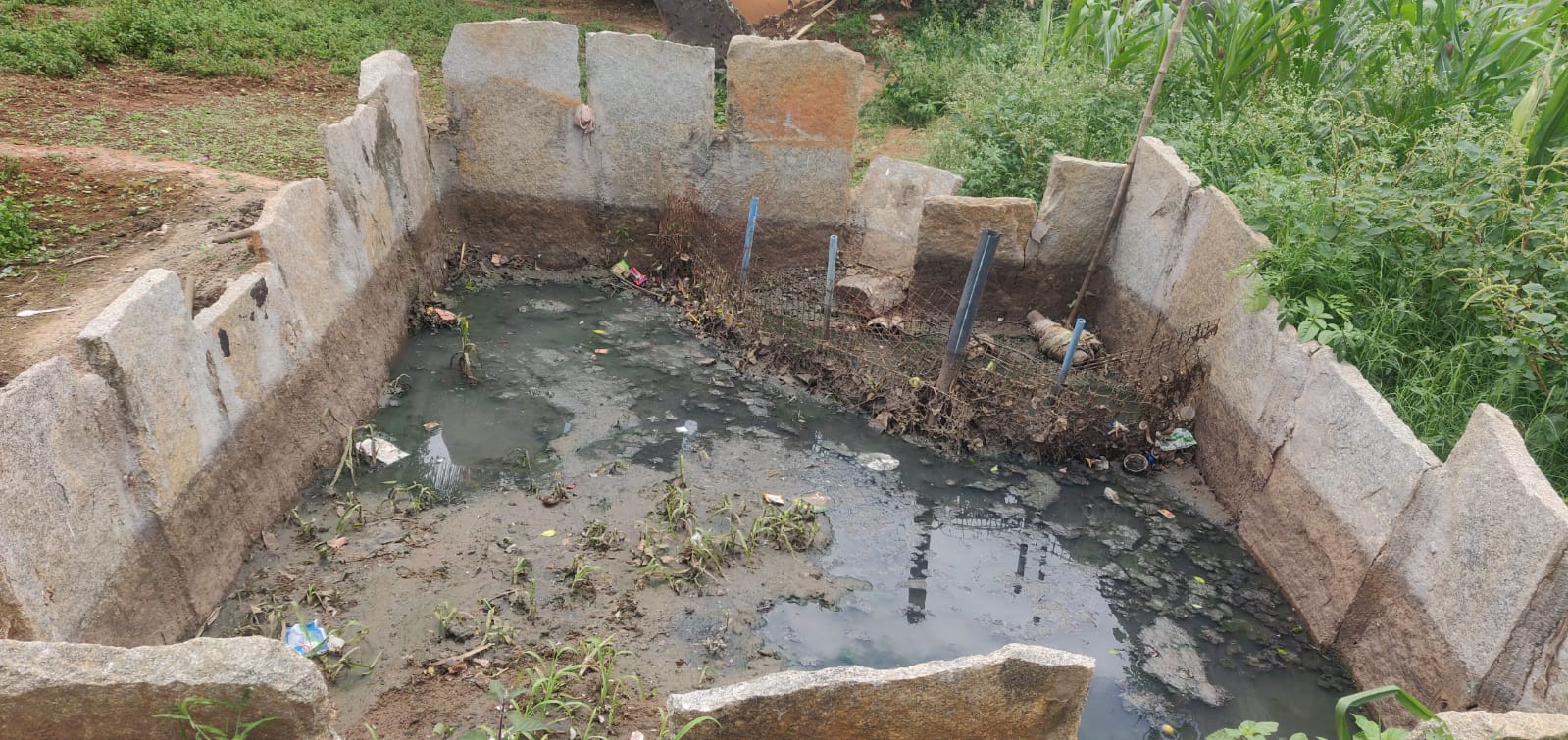
Here is another crude but effective design of a solid waste trap that is being used for a farm in Devanahalli. The farmer uses water from the stormwater drain and traps all the solid waste coming in with the net in the simple stone structure as you can see in the below picture.


A floating trash barrier developed by AlphaMERS Ltd. won the clean water body challenge using simple and crude mesh methods. This has helped clean up some prominent lakes in the country. A screenshot of the article has been attached below.


Wednesday, February 1, 2023

The 50 Wells of Electronic City

About Electronic City


Image 1: The area covered by Electronic City 

Electronic City is the IT hub of Bengaluru. It is divided into 4 phases or zones that stretch across an area of 800 acres between Konappan Agrahara and Doddathogur village — making it one of the

largest IT parks in the country.

It was established in 1978 by Kenoics. In 1997, Kenoics passed down its local governance and managerial responsibility to the Electronic City Industries Association (ELCIA). 

In 2013, it was declared an industrial township where ‘all services related to estate maintenance, safety, waste management within the township jurisdiction, will be the responsibility of Electronics City Industrial Township Authority (ELCITA).’

About the Project

This blog documents the ongoing rainwater harvesting (RWH) initiative taken by ELCITA to dig 50 recharge wells in Electronic City Phase 1. 

The sibling well-diggers, Yellappa & Muniappa, have been carrying out the project as per the direction of ELCITA.


Image 2: This is an Old Recharge Structure where a bore has been dug next to an existing recharge well


          Image 3: NRC with easily openable doors Indra Nagar Main Road


These recharge structures are of two kinds, where a: 

  1. bore has been dug next to an existing recharge well (Old Recharge Structures-ORS)

  2. bore is dug inside the recharge well (New Recharge Structures-NRS)

The NRS can be differentiated from the ORS as they have openable iron doors.

The diagram below shows the structure and mechanism of the NRS:


Image 4: Longitudinal view of newly dug well


The well-diggers note that the bores are used for recharging rainwater and not extracting groundwater. They said that the recharge rates of the wells have not been tested.

So far 19 out of the 50 estimated wells have been dug in three different locations of Electronic City Phase 1. They are:

I. Indra Nagar Pavement

Image 5: Some of the NRS  that have been dug between 2021-22. 


The image below shows that rainwater flows from the Indira Nagar Main Road into the drain (through a drain in the pavement) and then into the recharge well for percolation. 

II. ELCITA Office:


Image 10: ELCITA office

The ELCITA office has a rooftop RWH system. The rainwater from the roof is directed into two recharge pits of 3-feet diameter, 10-feet depth, and of 2000 liters capacity. 


Image 11: Recharge pit 1 in the ELCITA premises

Image 12: Recharge pit 2 in the ELCITA premises


  1. Karnataka State Small Industries Development Complex (KSSIDC) 

Image 7: The entrance to the KSSID Complex                                    

Many recharge structures are being dug in different parts of the KSSIDC property — which are still in the rudimentary stage of construction.