Sunday, April 26, 2015

Jakkur lake ecosystem and its challenges

There is something unique to the Jakkur lake ecosystem; lake filled with water, a sewage treatment plant (STP) near the lake site which disposes the treated water into the lake helping in maintaining the water balance, a constructed wetland, numerous open wells, fishermen and farming community using the lake for fishing, irrigation, and other domestic uses. Yet, it will be unfair to say it is free of challenges. Understanding the working of this ecosystem, the challenges involved by interacting with the lake group, JalaPoshan, actively involved in conservation activities of the lake was thus the main agenda of visit to Jakkur Lake on Sunday, 19th April, 2015.

Story of Jakkur Lake:

Jakkur Lake is situated at north eastern part of Bengaluru city with an area of 160 acres. A 10 MLD STP with Upflow Anaerobic Sludge blanket (UASB), a secondary level of treatment, has been set up by BWSSB at the lake site since 2004. Treated water from the STP is supplied to Bangalore International Airport along with allowing it into lake. However, the quantity given to BIAL is not known. The restoration work by BDA, from 2008-10, resulted in bunding of the lake, fencing and setting up of constructed wetland.

Timeline:


Satya Foundation (http://www.satyafoundation.in/program_parisara.php), a charitable trust, working in nature conservation and believing in participatory engagement got associated with Jakkur Lake through their programme on Preservation and Conservation of the Jakkur Lake , “JALA POSHAN - Sustaining Lake restoration” during the BDA restoration work. The engagement with the lake increased multifold when the restoration work was over and sustaining the restored lake became the focus of the group. The programme JaLa Poshan has resulted into official formation of JaLa Poshan group with the responsibility of maintaining the lake in 2014. In October 2014, the lake was officially handed over to BBMP and the process of adoption of lake geared up in the meantime.    

Currently, process of adoption of lake and signing a MoU with BBMP with a 3 year contract is underway. The terms and conditions of the MoU include- infrastructure and security provision by BBMP and regular monitoring and maintenance by JalaPoshan group.

The community:

The village lake earlier was a source of water for farmers staying close by. The lake was a shallow irrigation tank providing water for the fields and the animals as well. It was alsosource of water for more than 50 dhobis. Other activities like washing clothes, fishing used to happen and still happen. During summers, the lake used to naturally dry out and farmers used to de-silt the lake themselves. The silt was a good fertile soil beneficial for farming and was even sold to different areas earning the group of farmers some extra revenue. The fishermen community also helped in desilting work. 

Water quality:

After the lake restoration work was finished, there was no check on the water quality of the lake in the meantime. The in-house laboratory of the STP checks the inlet and outlet water quality at STP level daily. However, since the involvement of JalaPoshan group, once in a week or once in 15 days two people from the group ensure that samples are collected from the lake and get it checked in the lab. The results show that the STP outlet water quality is better than the lake quality. The reason could be attributed to the fact that there are three other inlets, stormwater drains to the lake, which carry sewage along with the rainwater affecting the water quality. 

Though the before the restoration and setting up of STP and after the STP comparison about water quality is not available for this lake, please see this http://www.ijser.org/researchpaper%5CAssessment-of-Surface-Water-Chemistry-of-Jakkur-Lake-Bangalore-Karnataka-India.pdf a study in 2013. The study concludes that the water is suitable for irrigation purposes. However, the direct correlation between establishment of STP and the water quality has not been established so far. The continuous monitoring by the group subsequently would shed more light on this.

The current status:

As of now, limited fishing activity happens in the lake with the fishermen signing a contract with fisheries department and breeding Rohu, Katla, Jalebi fish varieties. The water is being used for washing, irrigation, etc.

The group is currently in the process of adoption of the lake and subsequently working on the conservation plan for the lake. The immediate things to focus have been identified by the group:
  • Since the wetland has not been looked after planting, the immediate focus is to engage with experts like Dr. T V Ramachandra from IISc, Bangalore to scientifically understand the steps to be taken.
  • The lake is haven for the birds with many species recorded till now by different volunteers. The herpetology survey conducted by Agumbe research center in February 215, also recorded many species of snakes and other reptiles in the vicinity. The results of the survey to understand if any pattern or clear conclusions can be made are yet to be out. Thus, the focus is also on maintaining the biodiversity around the lake.
  • Indeed, issues have been identified with the wetland as it hasn’t been harvested and also with STP. Sometimes the STP is not functioning and getting in touch with the STP operator is the way through which they address the issue. Moreover, to understand the inflow characteristics, sewage inflow rate, water balance, water quality, ATREE is initiating a study as well. 
        
        We would like to thank Dr. Annapurna Kamath and members of JalaPoshan group for an enriching experience.


STP outlet to the wetland


Monday, March 30, 2015

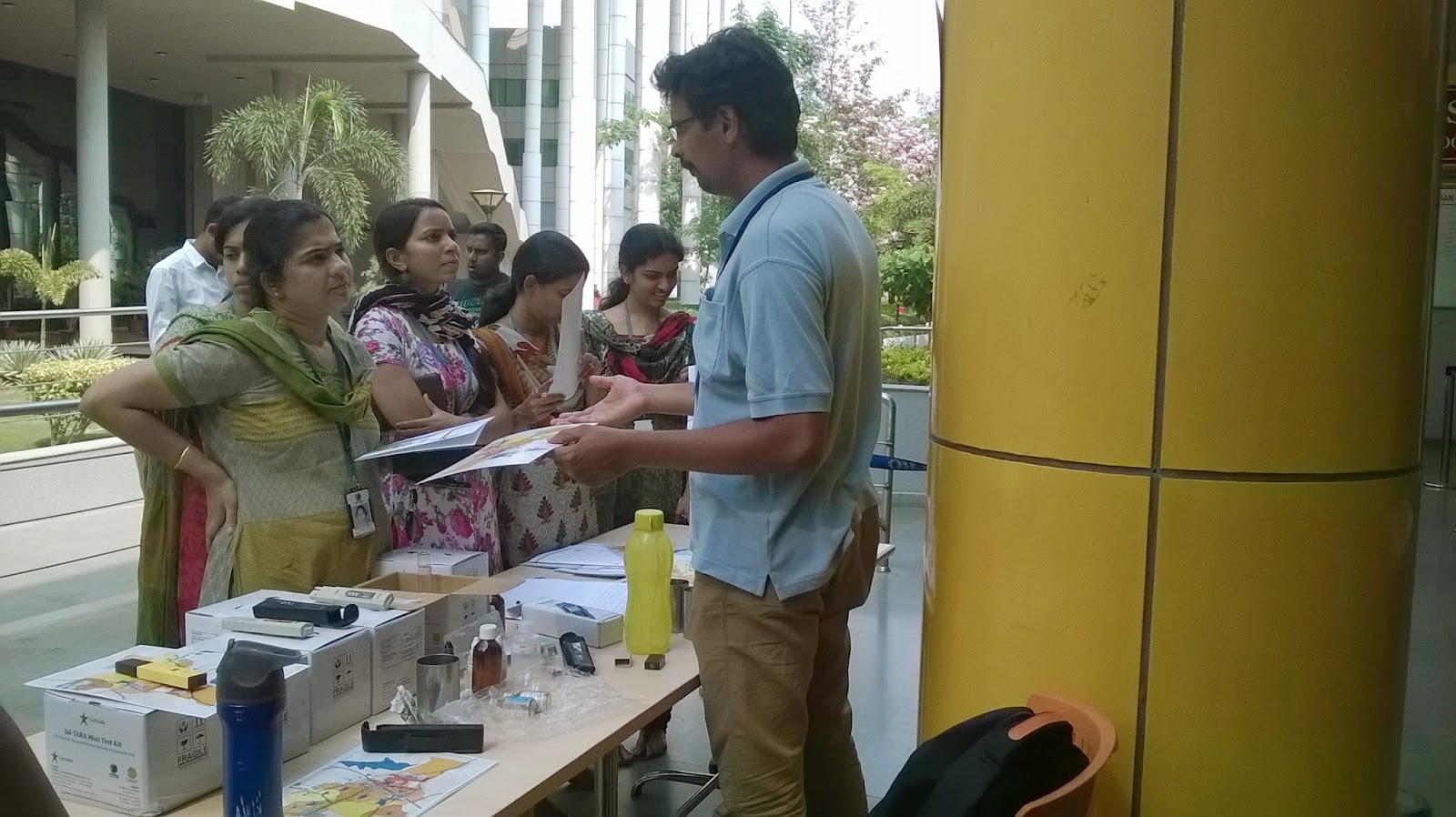
World water day at WIPRO Sarjapur Campus, 25th March 2015

WIPRO, a corporate group, has been engaging in many water sustainable practices over a period now. The team at WIPRO also supports the aquifer mapping and lakes bio-remediation projects in Bengaluru. Wipro employees staying in the area falling under Sarjapur-Bellandur watershed have been helpful in providing information about their borewells also.

As part of the world water day, a small event was arranged in WIPRO Sarjapur campus wherein the activities comprised of conducting water quality tests on the samples brought by the employees and share the information about aquifer mapping project, lakes bioremediation activities. The water quality tests conducted included pH, TDS, Electrical conductivity (E.C), Salinity, Fluoride and bacterial. The vials for the bacterial testing were given away to the people as the time taken for the results to show up is 24hrs-48 hrs. The sharing of information about the projects was done through elaborating on the watershed map, a small story book on sewage mining.

The feedback of the employees was overwhelming with people remembering to get their own water samples to office and taking the bacterial vials at home for testing on their own.


We would like to thank Lingaraj Dinni and other members from WIPRO for giving an opportunity to be part of this event.


Sunday, March 29, 2015

World water day at Rainbow Drive layout, 22nd March, 2015

Is there any other better way to celebrate world water day than at Rainbow Drive layout in Bengaluru? Rainbow Drive has been a pioneer in many good practices towards water sustainability and this was one such occasion which provided an opportunity to celebrate that spirit of working towards water self-sufficiency.

The citizen participation in the projects closes or at least inches closer towards end when the citizen themselves take over the activities and start championing the activities. The involvement of young generation in taking photographs and developing a movie on the good practices followed in the community, the residents themselves talking about the current practices and interventions around solid waste management, recharge wells, rainwater harvesting, etc. made the event much more valued. A presentation by Avinash Krishnamurthy from BIOME on how RBD has changed from a situation of any other layout in the city struggling with water issues to water sustainable community over the years was one of the highlights of the even as well.

On occasion of this day, a Phytorid based sewage treatment plant was officially inaugurated by Upa Lokayuktha, Justice Subhash B Adi. Justice Adi, who has been hearing cases around issues of water bodies, especially lakes in Bengaluru praised the efforts undertaken at RBD and encouraged others to follow it.

Amidst the chaos created by many discussions around sewage treatment, recharge well, rainwater harvesting, aquifer mapping, lakes bioremediation, etc. and the brazing heat, cool coconut water was indeed refreshing.


We would like to thank K P Singh and RBD plot owners association for their support in organizing this event. 


Wednesday, March 25, 2015

Citizen dialogue with Karnataka State Pollution Control Board (KSPCB), 20th March, 2015

At the time when gap between theory and practice seems to widen, if focused efforts are put together by creating a space for interaction between citizens and the government an effective outcome is never far. With this in mind, a citizen dialogue was arranged with KSPCB chairman and officials from KSPCB on a concerted issue of reusing excess treated wastewater.

Background:

Recent times Bengaluru has witnessed many of the big lakes turning into sewage pools, while a considerable number of lakes have turned to dry bed. Moreover, the Sarjapur-Bellandur area watershed boundary is dependent entirely on groundwater with hardly any recharge. Thus, continuous extraction of groundwater from deep aquifers, little or no recharge, blockages in the stormwater canals have all contributed to the lakes drying up.

Additionally, in areas with no underground drainage system, KSPCB has established zero discharge norms which applies to this watershed as well. It implies that sewage generated in the campus (of apartment, layout, institutions) should be re-used within the campus itself. However, even after using the treated water for gardening, flushing, there is still a significant amount of excess treated wastewater available.

Owing to the issues of depleting groundwater levels, lakes turning into sewage pools and some drying up, solutions like disposing excess treated water into lakes, using excess treated water for recharging shallow aquifers, and for other purposes like construction, etc. started taking place within the community.

This meeting, a dialogue with KSPCB was thus, with an intent of reviewing possible solutions for reusing excess treated water, understanding the challenges and responsibility of everyone in the process of reuse.

The meeting started with an introduction from BIOME on the facts, assumptions about the watershed area of 33 sq. km:

Highlights of the presentation:
1.       Sarjapur-bellandur watershed is of 8000 acres
2.       Total water spread area 428 acre totaling 15 lakes(excluding Bellandur lake of 892 acre.)
3.       Total holding capacity 1731 million liter assuming 1 meter average depth.
4.        Evaporation loss: 2597 million liter annually, Percolation estimated: 6231 million liter annually.
5.       The capacity of total STPs in the area is approximately 8.5 million liter per day based on the information collected from KSCPCB regional offices.

Discussion:

The KSPCB Chairman Dr. Vaman Acharya, kick started the meeting saying, “If the question is whether the excess treated STP water can be discharged to lakes, given it abides the quality norm? the answer is YES. Because the secret of getting ahead is, getting started”.

The larger questions raised by the residents:

1.    If I do have an STP, but no dual plumbing to use it for flushing what do I do with the excess treated water ?  As lakes in the city are dry, isn’t it a good idea to let in treated STP water into lakes – to have a perennial source of water? What do the discharge norms really mean? Where do I discharge this treated water? It seems like a shame to put it back into sewer lines to mix this with other raw sewerage and that too for a price!(@Rs 100/- per month per home) when I have spent significant time and money to treat the water - in the first place.

2.    I have an STP and dual plumbing. I am using the water for gardening and flushing. I still have excess treated water. I am told that I should not discharge any treated waste water outside my campus. What do I do? If I am sending water outside my campus am I breaking the law?

3.    I know my treated water quality is good. Is it ok to let it into the shallow wells for shallow aquifer recharge?

4. It is possible to reuse the treated water for construction purpose?

The challenges that need to be addressed:
  • How to maintain the quality of water?
  • Who would be held responsible while ensuring the water quality?
  • The efficiency, scientific validation and economic viability of the chosen solution.
  • Legal Dos and Don’ts

Proposed recommendation on experimental basis:

After a thorough discussion between chairman, and participants below propositions evolved:

  • Make a separate outlet/piping to bring the treated water directly to lake.
  • Land use application norms would be applicable for comparing the treated water quality for letting into lake or into shallow recharge wells
  • Setting up small unit treatment plant at the inlet of the lakes on lake bed (probably in the buffer zone) to ensure control on water quality.
  • If the residents are sure of the quality with evidence and directing to lake is not a viable option (far off from the lake) then they may let it to shallow recharge wells.
  • For areas with BWSSB connection and underground drainage network: Apartments/ layouts with in-house STP can allow the treated water into nearby lake
  • For every initiative to do the above form a group of 5 individual (+/-1) from each authorities: Member of citizen's group, personnel from pollution control board, NGO, lake development authority/BWSSB/BBMP.  To have the water quality tested weekly to see the persistent goodness level.

Go Ahead, Conditions applied!!

It has been advised and seeded to all the participants to come up with concrete proposals based on the alternatives proposed in the meeting.

The following data would have to go into the proposal

  1. Name of the apartment, number of flats/houses, STP capacity, daily treated volume, approximately amount of excess treated water generated daily
  2. The group that is willing to take responsibility for the lake/process
  3. Preferred way of disposal: Lake/recharge wells
  4. Current Depth/Volume/Quality/Other Details like distance of lake from the site (approximate) of Lake/Recharge structures
  5. Volume/Quality of water that is expected to be discharged
  6. The process of discharge - time of discharge/process for monitoring (what parameters will be tested, by who, at what frequency)

Documents that need to be submitted along with the proposal: CFE/CFO for STPs, water quality reports for the past 3 months at least to check the consistency

Next Steps:

Submit the proposals to KSPCB regional office (BIOME would facilitate this) for getting the permissions.

KSPCB would also engage with LDA to discuss the issue along with the citizens as with the new amendment in the Lake development act, LDA would get more authority.


We would like to thank all the participants who attended the meeting and shared their experiences. We hope that the meeting was fruitful for everyone and assure that further steps would be soon initiated.

Participants:
Dr.Vaman Acharya, Chairman , KSPCB,
Venkatesh Sekar, Senior Environmental officer, KSPCB
Mr. Shivlinge Gowda, Officer in charge-Apartments, KSPCB
And other environmental officers and staff from KSPCB
Engineers from Lake Development Authority,
MAPSAS
Independent consultants
Lake Enthusiasts
Apartment representatives and
BIOME.­­­­­­­­


More pictures can be viewed here: https://plus.google.com/photos/111781758596840598341/albums/6129725615636884465

Thursday, March 5, 2015

Visit to Cubbon Park Sewage treatment plant

On the day of 21st of February, Saturday sharp at 10 o'clock morning, the lake conscious team gathered at Cubbon Park with an agenda of more familiarity with Cubbon park Sewage Treatment Plant. The purpose is to evaluate the technology for its viability for sourcing  treated sewage water to the lake rejuvenation.

In a gist “The Cubbon park treatment plant is 1.5 MLD capacity using MBR (Membrane Bioreactor) coupled with aeration technology, setup in 2004/2005, at a cost of > Rs 4 Cr with a footprint of 0.8 acres on a 2 acres plot”. The idea was to tap 1.5 MLD sewage from neighboring drain and use the cleaned water for gardening purposes of the park. This was achieved by letting out clean water of < 2 BOD consistently. The plant spends Rs 2 lakhs per month on electricity. Simplified cost is Rs 12/- per KL. The STP is completely automated and most operations can be carried out from the office using SCADA systems, leaving human factors to 15 employees only. For 2004/2005 it was surely efficient enough, to see if this holds good in 2014/2015 let us see the operational details below:

Process:
Step 1: Sewage is let to flow from the drain to wet settler tank by screening through a 3 cm gap screen, To stop the bigger objects like blanket, utensils, dead animals etc.
DSC01958.JPG
Step 2: Four pumps are then engaged in pulling the water from the tank to two new chambers say ‘A’ and ‘B’. The total flow capacity of the 4 pumps is 55.25 cu.meter.
DSC01961.JPG
Step 3: Both chamber “A” and “B” has a 6 mm screen each to further filter out heavy particles before letting in a common chamber say “C”.

Step 4: From “C” then with the help of two pumps it again passed to two chambers say “D” and “E” having 0.8 mm filtration screen each.
DSC01966.JPG
Step 5: From “D” and “E” via a distribution channel it then passed in two big aeration tank say “M” and “N”. The depth of each of the tank is 4.29 meter. Air is passed into each of the tank from two air blowers. Here the aerobic digestion takes place. From this tank the final sludge is removed.
DSC01971.JPG

Step 6: Following that the treated water is passed through Chlorine bed for disinfection by passing jet of Sodium hypochlorite.

Step 7: Further it is made to pass through Activated carbon filter for odour removal and dechlorination. Because Chlorine is a toxic substance which makes it ideal for killing harmful pathogens, but it does not stop there. If chlorinated water were released into the garden it would also be harmful to soil,plants and any other living organisms it contacts.
DSC01973.JPG
Step 8: While the Treated water is stored in a tank for irrigation, The obtained sludge is removed and dried in sludge bed and generally used for landfilling.
DSC01977.JPG

Quality: less than 2 BOD but contains Nitrate and Phosphates which is not a threat in this case as it is considered that both will be absorbed by plant as nourishment.
DSC01974.JPG
Maintenance: Major action involves cleaning up the clogged membrane. It is achieved by backwash technique. Sodium hypochlorite and Citric Acid jet is used for this purpose.  
DSC01976.JPG

Tuesday, March 3, 2015

Weather Station Install in Rainbow Drive

An automatic weather station (AWS) was installed on 28th February in Rainbow Drive. The install was a part of the Aquifer Mapping Project and attempts to monitor weather related and specifically rainfall data at a very localized level.

The installation was done by Yuktix (a start up based in Bangalore). The system has two main components - 1. The sensors for Atmospheric Pressure, Humidity, Temperature and the rain gauge
2. The controller which quantifies the data recorded by the sensor and broadcasts it to a cloud based server.

The Rain gauge is a tipping bucket type system. Each tip accounts for a 0.01 inch rainfall and the number of tips every three minutes is recorded by the controller. The controller also polls the three other sensors every 15 seconds and the moving average of the sensed values of Temperature/ Pressure/ Humidity is calculated and broadcast to the server every third minute.
The broadcast is done with the help of a sim card embedded in the controller.

The data should be available in www.yuktix.com/m/aws in a few days after the initial testing for data transmission and integrity is checked for by the Yuktix team.