Tuesday, June 29, 2021

Presentation on Sanitation Safety Plan by Avinash Krishnamurthy

Sanitation Safety Plan(SSP) is a Manual developed by WHO, is a step-by-step risk based approach to assist in the implementation of local level risk assessment and management for the sanitation service chain - from containment, conveyance, treatment and end use of disposal.

To have a deeper understanding of SSP, on June 2, 2021 Avinash Krishnamurthy gave a presentation explaining what is SSP, its methodology, assessment and also discussed about Devanahalli's SSP example. It is a 50 minutes presentation including QnA session. 

  • Here is the link to the Power point presentation. 
  • Here is the link to the document on Devanahalli's SSP trial
  • Here is the link to listen to the presentation.

-Rakshitha M L

Sunday, June 27, 2021

BIOME's presentation on NIUA's 45th anniversary, 2021

BIOME Environmental Solutions is currently doing a research study funded by National Institute for Urban Affairs (think tank of government of India) with its consortium partners "People in Center" and "Megh Pyne Abhiyan". The study is being carried out in a duration of 9 months starting from January 1st 2021 and ending on September 2021. the aim of the study is to explore the next generation of urban sanitation, wastewater and fecal sludge management challenges in India and contribute to the developing of a body of knowledge that can inform practice in the urban sanitation sector in India and elsewhere.

The study area focuses on formal and informal sanitation practices in 9 Indian cities from 5 states, which are described in the table below:


Mr.Vishwanth Srikantaiah is the research lead for the study and from BIOME Miss.Shubha Ramachandran and Mr.Avinash are also involved.

NIUA completed 45 years of operation. On this special occasion, on 24th June 2021, the study team participated in the webinar on "Formal and Informal Sanitation Practices: Learnings from 9 Indian cities".

Here is the poster for the webinar:


Listen to the recording of the event on Facebook here.
Here  is the link to NIUA's Twitter post


- Rakshitha M L


Friday, June 25, 2021

12 years after Bengaluru’s water board made RWH a rule ...


Summer School for Women in Mathematics and Statistics in 2021

Shubha Ramachadran spoke to the students on June 2021 at ICTS-TIFR in Bangalore.

Topic : Groundwater and Us

Abstract

Nowhere is groundwater more important than in India where a quarter of the world’s groundwater is extracted annually—the highest in the world—which is greater than that pumped up by China and the United States combined. Up to 80 percent of the population relies on groundwater for both drinking and irrigation. In such a scenario how do we manage groundwater ? What is the Million Well campaign in Bengaluru about ? 

The summer school is intended for women students studying in first year B. A./B.Sc./B.E./B.Tech or equivalent degree and having Mathematics as one of the major subjects/courses, during the academic year 2020-21. Over a period of two weeks, the school shall aim at helping students develop problem solving skills in Mathematics and Statistics at the undergraduate level. The below website:

https://www.icts.res.in/program/swms2021 has rudimentary details about the program. 

This is the third edition. Previous year's school blog is at

swms2018.wordpress.com
swms2019.wordpress.com


Recording available here : https://www.youtube.com/watch?v=COqNGXaVH-c&t=45s


Saturday, June 12, 2021

Rejuvenation of Two Open Wells in Lalbagh


Lalbagh botanical garden is a 240 acres (0.97 km2) garden and is located in south Bangalore. It is managed by the Department of Horticulture, Bangalore. There are 5 open wells in Lalbagh. Of these 3 wells have water however, water from these wells are not being used. Two of the wells were closed by filling it with waste materials.  One of the closed wells was taken for rejuvenation in the month of March 2021.  After rejuvenation of the well 5ft of water was seen indicating the presence of shallow aquifer. With a pump house next to these wells indicated that these wells were used before borewell was introduced.


To manage the flooding in the north western part of the park during the rainy season, 100 recharge wells are being dug. This will help in recharging the aquifer and also  mitigate flooding.


Location of Lalbagh, Bangalore

Say Trees approached Biome Environmental Trust to identify a well in the city for rejuvenation.  The objective was to create awareness about the connection between groundwater, shallow aquifers and open wells. Since Lalbagh sees hundreds of people every day, rejuvenating a well in such a location will meet the objectives. 

To create awareness a poster/board will be placed with information next to the well. 

This project was funded by Say Trees.


Open Wells in Lalbagh

There are 5 open wells in Lalbagh.  Of these, 3 wells (Well no. 1,4,5) have water.  2 of the wells (Well no. 2 and 3) were closed by dumping construction debris, garden waste and other waste.  It was decided to take up Well no. 2, located close to the SunDial park, for rejuvenation. The dimension of the well is 10ft diameter  and 29ft depth.


WellDigger Ramakrishna inspecting Well no. 2 for rejuvenation


After taking the necessary permission from the Deputy Director of Horticulture, well digger Ramakrishna and his team started cleaning the well for rejuvenation.


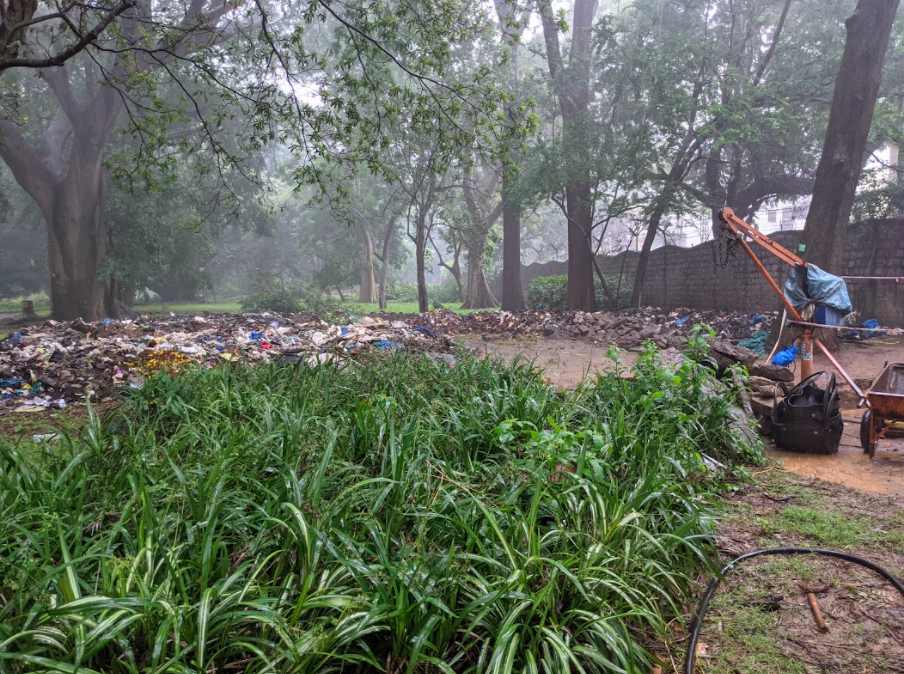
The well was filled with tree branches, leaves, stone, construction debris, paper and plastic waste.  Ramakrishna and  team worked for 14 days to remove the waste and completely clean the well. They used a crane to remove the heavy material and silt. They hit water at the bottom of the well. After cleaning and treating the well  5ft of standing clear water is observed.


Cleaning of the well


Well diggers removing the waste dumped in the well

Paper and plastic waste


Stone and construction waste


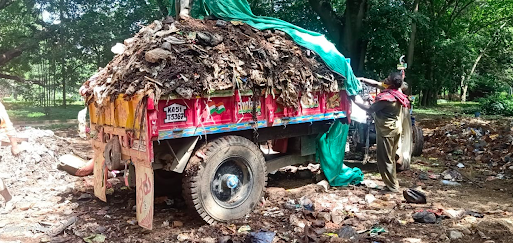
Tractors carrying the plastic and paper waste out of Lalbagh

Outside of the well after cleaning

8 tractor loads of plastic/paper waste were taken out of Lalbagh.  The stone, garden waste and silt was left in the garden to be used.

Inside the well after rejuvenation

The dimension of the rejuvenated well is 10ft diameter  and 29ft depth. The static volume of the well is 64000 liters.


A perforated metal cover with a door was fixed on top of the well for safety purposes.  This also prevents leaves falling into the well.


Perforated Metal cover 


Second well (Well no. 3)

Opposite The big Silk Cotton Tree - near the temple was taken up for rejuvenation in July 2021


This well was also filled with waste  such as garden, plastic, paper, construction materials etc.

Well diggers, Ramkrishna and team at the well to be rejuvenated


Status of the well before rejuvenation


Ramkrishna and team cleaned the well.  They used a crane to remove the heavy material and silt.

After cleaning the surrounding of the well

Waste removed from the well

                       
More waste being removed

They hit the bottom of the well at 37ft.They did not hit water and the well was dry. The next couple of days due to heavy rains the water started seeping into the well. 8 ft of water was observed in the well after two days of rain. The well is 13ft diameter and 37ft deep.

.
          Bottom of the well     Water seen in the well after rain

Approximately 50-60 tractor loads of waste were removed from the well.


Tractors carrying the waste removed from the well out of Lalbagh


As the well was on ground level a 2 ft parapet wall was constructed and a grill was fixed so that leaves do not fall into the well and hence the water remains clean.

.

A parapet wall and a mesh for safety and preventing leaf and garbage falling into the well. Helps keep the well and water clean.

A 3hp submersible pump has been installed inside the well. Now the water from the well can be used in the garden near the well.

Water from the well being used in the garden


Open wells help manage the shallow aquifer by being structures that can both draw water from the shallow aquifer as well as serve as structures that can recharge the ground. Open wells with water are also the source of water with the lowest amount of energy required to source the water. More details about Bangalore and its open wells can be found here
http://bengaluru.urbanwaters.in/our-open-well-heritage-510/


Tuesday, March 16, 2021

Water and sanitation in Devanahalli: Drinking water supply business

 Part 5: Drinking water supply business 


Southegowdanahalli is the only location where water is available at shallower depths and in plenty throughout the year. Mr.Krishnamurthy is a successful entrepreneur running a commercial drinking water supply business since 2002. Krishnamurthy supplies 50,000-100,000 litres of water every day. He is majorly supplying water to two apartments like Brigade and other apartment.

Businessman Mr.Krishnamurthy

  • He has 3 water tankers having the capacity 12,000, 4000 and 3000litres each. Mostly 12,000litres capacity tanker is put into use(which saves on the cost)
  • For 4000litres capacity tanker Rs.400 is charged. There is no GST charged for water supply 
  • Mr.Krishnamurthy has 4 borewells at 700, 300 and two borewells at 250feet in depth drilled in 2013,2014, 2015 and 2016. Each borewell is yielding about 1 inch water. 
  •  His business is having the current demand of 50,000litres a day. Krishnamurthy is fully equipped to supply around 150,00-180,000 litres a day. 
  • The water storage sump is of the capacity 100,000litres which is at the basement of his building.
  • He is also practicing groundwater recharge from the outflows from the tankers. The recharge well is 20feet in depth. 

Basement sump


Recharge well 


  • He shifted to solar panels in the year 2014 to cut down cost incurred on pumping. Every month Rs.60,000-70,000 was the cost incurred on pumping the groundwater. After shifting to solar panels the cost incurred on pumping has come down to Rs.5000 which is mostly due to non sunny days. The capital cost on solar panels is at Rs.740,000 which can generate 6.5kilowatt of electricity. In his words, “I have recovered the capital cost on solar panels within a year in the form of cost savings on the electricity bills. I have benefited the most from Solar panels.”
  • For each borewells one hp motor is put into use.
  • On groundwater he says the surrounding 150acres has a high Groundwater table. It is ideal to tap top soil water. As the borewell goes deeper there are less chances of striking water. 
  • Every day the entrepreneur checks for TDS levels in the water where the counts were .36 and .40 when he demonstrated the testing. 
  • The entrepreneur is planning to expand his business by installing a new RO plant where he can supply bottled water. He is aiming to provide 20litres of water at a competitive price of Rs.4 where he confidently says he could still be able to make profits. 

- Rakshitha M L

Water and sanitation in Devanahalli: Honey suckers


Part 4: Honey suckers


Devanahalli town is entirely dependent on on-site sanitation having pit toilets and septic tanks. Devanahalli has majority of pit toilets than septic tanks. Pit toilets are made up of cement rings varying from 10-15 feet in depth. In old houses, pit toilets are comparatively bigger in size and are made up of stones. Pit emptying cycle is driven by seasons. In summers, fecal sludge is said to be more dry. During monsoons absorption of fecal sludge by the ground is said to be low. Thus pit emptying is said to be more during monsoons.

Honey suckers play a vital role in emptying, transporting and disposal of fecal sludge. There is a combination of both private and government honey suckers in the town. There is one government owned and four private owned honey suckers in Devanahalli. Government honey sucker is almost a decade old and lack the manpower meaning it gets to operate when a driver is available. The four private honey suckers are owned by Narasimha Murthy, Punith, Ramesh and Kiran. Government owned honey sucker charges Rs.1000 to empty a pit toilet and Private honey suckers charges Rs.800 on an average (price is kept low to compete with government honey sucker). A pit toilet can usually have 1000-1500 litres of fecal sludge. Honey suckers are usually of 3500-4000 litres capacity. A honey sucker can accommodate more pit toilets (3-4 pit toilets) in summer when compared to winter(1-2pit toilets). On an average a honey sucker can accommodate 1-2 pit toilets. 

Honey suckers are asked to dispose fecal sludge only in the Fecal Sludge Treatment Plant(FSTP). TMC puts fine on honey suckers disposing fecal sludge in the open fields.


Honey sucker emptying the fecal sludge in FSTP


Honey sucker operator Kiran: Honey sucker operator Mr. Kiran makes about 1 to 3 trips a day. Three is the maximum trips he makes which will be 12,000litres of fecal sludge in quantity. He says in recent years the number of rented houses are more in number and the pit toilet contains about 3000litres of fecal sludge. "If we dispose fecal sludge in open spaces TMC will fine us. If the capacity of FSTP is full, TMC asks us to dispose in the open fields more than 5kms away from the city. When the FSTP is full or far from the collection point and if farmers are not taking fecal sludge we dispose of FS in open farm fields, mostly when the crop is harvested so it also helps the future cultivation. I think the capacity of FSTP is very less."

Honey sucker operator Punith: Mr.Punith's honey sucker is having 6000 litres of capacity. He mostly takes grey water from the commercial plots which is allowed to be dumped in farm fields. According to Punith, "the collection tank has just 5000 litres capacity. It takes more time to empty my honey sucker in the FSTP. I have to wait for one to two hours just to unload. I have to be competitive in my business, I cannot afford to say no to calls I get from households and thus I have no other choice to find a dumping place elsewhere after TMC limits. FSTP is a good initiative but it is not executed properly. There is a strong need to have big sumps."

Honey sucker operator Ramesh: Mr.Ramesh is a 45year old honey sucker operator who mostly serves within Devanahalli town. According to Ramesh, "We cannot find an open space to empty the fecal sludge. People question us if we dump in open spaces. During the rainy season it becomes all the more difficult. Thus having a formal disposal site helps us. FSTP capacity is very less. Rajkumar asks honey suckers to wait or to come back after an hour if both the tanks are full. Least it should accommodate 8 trucks. If FSTP are created in other places like in Chikkaballapur it helps us. "


- Rakshitha M L